First US Resume Playbook for Immigrants & Newcomers
Your experience is real. But if your CV follows London, Berlin, or Mumbai conventions, US screeners misread it in the 7 seconds they give it. Here's the conversion — section by section.
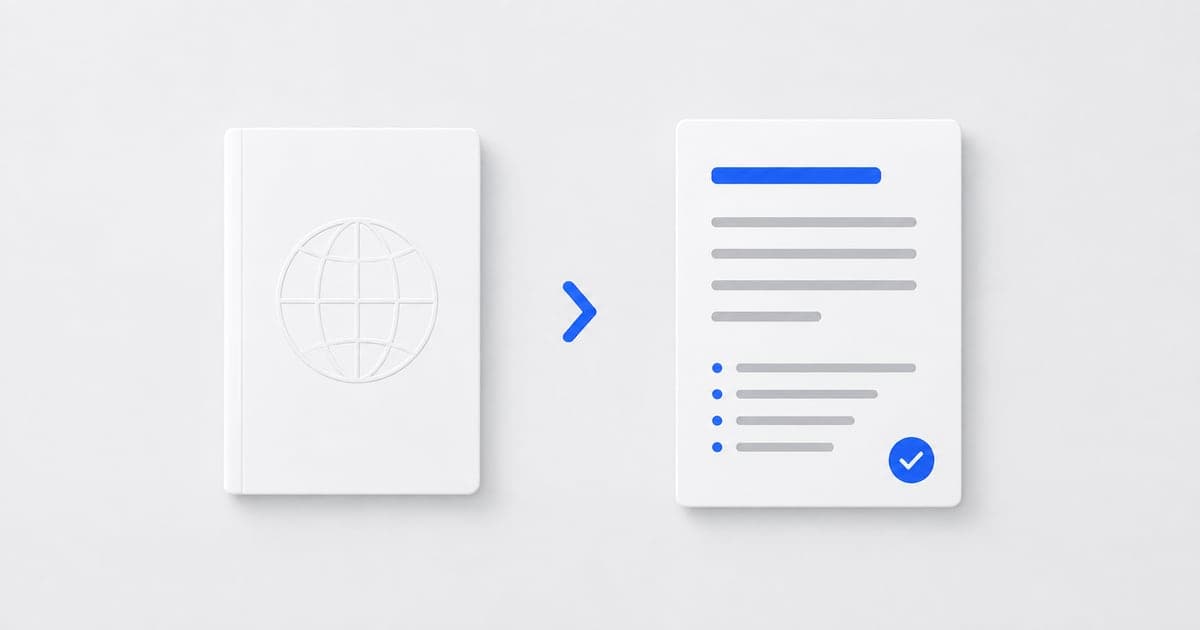
Short answer: a US-ready resume means no photo or personal data, functional title translations, education stated accurately with US equivalents where known, quantified achievements instead of duty lists, and posting-mirrored keywords — on one clean single-column page (two if senior). Everything else is detail; this is the frame.
What changes first: the personal layer
Many countries expect photos, birth dates, marital status, or nationality on a CV. US resumes exclude all of these — recruiters are trained not to use them, and including them reads as unfamiliarity rather than thoroughness:
- • Photo → remove entirely
- • Birth date, marital status, nationality → remove
- • Full street address → city and state is enough
- • ID/passport numbers → never
Translating titles, companies, and degrees
The goal is comprehension without fabrication. A screener in Ohio can't evaluate "Ingénieur d'Affaires at a grand école spin-off" — but they can evaluate the translation:
- • Titles:keep the original, add a functional US equivalent in parentheses — e.g., "Referent (equivalent: Team Lead, Customer Operations)"
- • Employers: add one context line — country, industry, scale. Recognizable names need no help; unknown ones do.
- • Degrees: state exactly what was awarded, then a US-equivalent note where confident; credential evaluations exist for formal cases.
From duties to quantified achievements
US resumes sell outcomes. Many work cultures emphasize responsibilities and process; the US screen rewards results with numbers:
Duty-style
"Responsible for managing supplier relationships."
US achievement style
"Managed 14 supplier relationships across 3 countries; renegotiated contracts cutting lead times 22% year over year."
Visa status: where it belongs
Not on the resume. Answer authorization questions accurately in application forms and conversations; oversharing on the document only invites early filtering. Employers who sponsor know how to ask what they need (more immigrant-specific guidance here).
The first-application checklist
- 1. Personal layer stripped — no photo, no birth data, city/state only.
- 2. Titles translated with functional equivalents in parentheses.
- 3. Employer context lines added for every non-famous company.
- 4. Education accurate + US-equivalent notes where confident.
- 5. Three achievements quantified per recent role.
- 6. Posting keywords mirrored honestly.
- 7. Format: single column, standard headings, PDF, one page (two if 10+ years).
Keep one version of your truth
The trap for newcomers is maintaining separate resumes per market until facts drift apart. Better: keep one structured career history and generate market-specific formats from it — which is exactly the model behind ElevateAI's immigrant-focused workcenter and our German/ French conversion guides.
Frequently asked questions
Should I include a photo or personal details on a US resume?
No. US convention excludes photos, dates of birth, marital status, nationality, and ID numbers — partly for consistency and partly because employers work to avoid bias-related information. Include name, city/state (not full street address), phone, email, and LinkedIn. If you're unsure what an employer expects, their posting language is the best guide.
How do I write foreign employers on a US resume?
Keep the real employer name but add one line of plain-language context: country/city, industry, and size if impressive ('a 4,000-employee logistics group'). Translate your title functionally — 'commercial attaché' becomes the closest US equivalent in parentheses — without changing what you actually did.
How should I list a foreign degree on a US resume?
List it accurately with the original institution and country, plus the US equivalent in parentheses when confident (e.g., 'Licenciatura em Engenharia (equivalent to BS, Engineering)'). For regulated professions or when an employer asks, a credential evaluation from a service such as WES translates your qualification into US terms.
Should I mention visa status on my resume?
Generally no — handle work authorization during applications or conversations, not on the document itself. If a posting explicitly requires authorization details up front, answer those questions in the application form honestly and precisely; the resume stays focused on your qualifications.
Related guides
- → Resume Builder for Immigrants & International Candidates
- → German CV vs US Resume
- → Career Change Resume Guide
- → Who ElevateAI is for
One career memory, every market's format
Enter your experience once; generate US-format resumes, tailored to each posting, in English or four other languages. Free tier includes one AI-scored saved job.
Start free